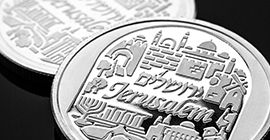
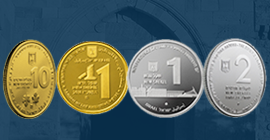
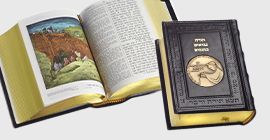
Gates of Jerusalem Silver Set - A prestigious collection featuring the eight historic gates of the city of Jerusalem, beautifully crafted in pure 999 silver.
A fascinating journey along the walls of the Old City of Jerusalem and its eight gates.
The Walls around the Old City of Jerusalem were built in the 16th century by the Sultan of Turkey, known as Suleiman the Magnificent. Eight gates were constructed within the Walls.
The gates are open and serve as passageways to the sacred and historical sites and markets of the city, with exception of the Golden Gate which remains closed. It is said that this gate will be opened miraculously, when the Messiah comes and the dead are resurrected.
The limited edition Gates of Jerusalem series, struck in 1 oz fine silver, will take you on a memorable tour reflecting thousands of years of history.
1. Jaffa Gate
Located close to the Tower of David, "Jaffa Gate" is so called because it is a starting point to the ancient
Port of Jaffa on the Mediterranean Coast. The gate was built by Sultan Suleiman I, in the mid 16th century during Ottoman rule. Carved in the stone above the arch of the gate is a large inscription with the name of the
builder and year in which it was built.
For reasons of defense, the entrance of the gate was built at an angle.
2. Lion's Gate
The Lions Gate, built in 1538-1539, is so called because of the two sculpted lions that decorate either side of
the gateway. It is said that Sultan Suleiman the Magnificent requested that the lions be sculpted, following his dream in which he was warned that if he did not defend Jerusalem by building a wall around the city, he would be devoured by lions.
The gate is situated in the eastern wall, close to the Moslem Quarter facing the Mount of Olives.
3. Damascus Gate
Damascus Gate is so called because the northward route from the Gate led to Damascus.
Archaeological excavations have revealed gates from former periods beneath the Damascus Gate built in the Ottoman period; in the lower layer, remains of a first century BCE gate built by King Herod in the Second Temple period, and above, remains of the gate from the Roman period.
Damascus Gate is considered the most impressive gate among the eight gates in the walls of Jerusalem.
4. New Gate
The New Gate was built in 1889. Relatively speaking, it is the newest gate out of the main 8 gates in the walls
and was built at their highest point. It rendered the passage between the Old City of Jerusalem and the
Christian institutions across the street, more convenient.
While the other gates within the walls are more impressive in appearance, the New Gate is plainer and consists of a single opening in the wall.
The Gate was blocked from 1948, when it was closed by the Jordanians, until 1967, when it was reopened by the IDF after the Six-Day War.
5. Golden Gate
Unlike the gates in the Walls of Jerusalem, the Golden Gate was not built by the Turks. It was constructed in the 7th century over ruins dating back to biblical times, possibly even to the time of the first Temple.
Decorated with Byzantine-style elements, it has two openings, both of which were sealed by the Ottoman Sultan Suleiman in 1541 to prevent the entrance of the Messiah, which according to Jewish tradition will enter through this gate.
According to Christian tradition, the gate is called "Golden Gate" because it is said that Jesus entered Jerusalem through this Gate.
6. Dung Gate
Located in the southern wall of the Old City of Jerusalem, Dung Gate is the nearest to the Western Wall. Unlike the other gates in the walls, Dung Gate was built as a small passageway, big enough to allow just a person and animal to pass through. An arch above the gate, with a Star of David inside it, shows the width of the original gateway.
In 1952, the Jordanians significantly widened the gateway and paved a road through it, after liberation of the city by the Israel Defence Forces during the Six Day War, the Dung Gate was renovated and preserved by the State of Israel.
7. Zion's Gate
For its proximity to Mount Zion, the Gate bears the name Zion Gate. It is also known as David's Gate, for being
near to King David's tomb on Mount Zion. Close also to Zion Gate are the Room of the Last Supper and the Dormitory Abbey, holy sites in Christian tradition.
Zion Gate leads directly to both the Jewish and Armenian Quarters. The many bullet holes in the gate are a testimony to the battle that took place in May 1948 at the beginning of the Israel War for Independence.
8. Herod's Gate
Some believed that the Gate led to Herod's palace, hence the name "Herod's Gate".
At the beginning of the 19th century, the gate was blocked with stones to prevent entrance and was reopened in 1875 by the Turks. Originally, entrance to the gateway was from the side for defense purposes.
When the Turks opened the gateway, they opened it from the north-facing front side in order to provide easy access to the new neighborhoods that were developing northwards.